The question your reports don’t answer
Every marketing report answers a question. Most of them answer the wrong one.
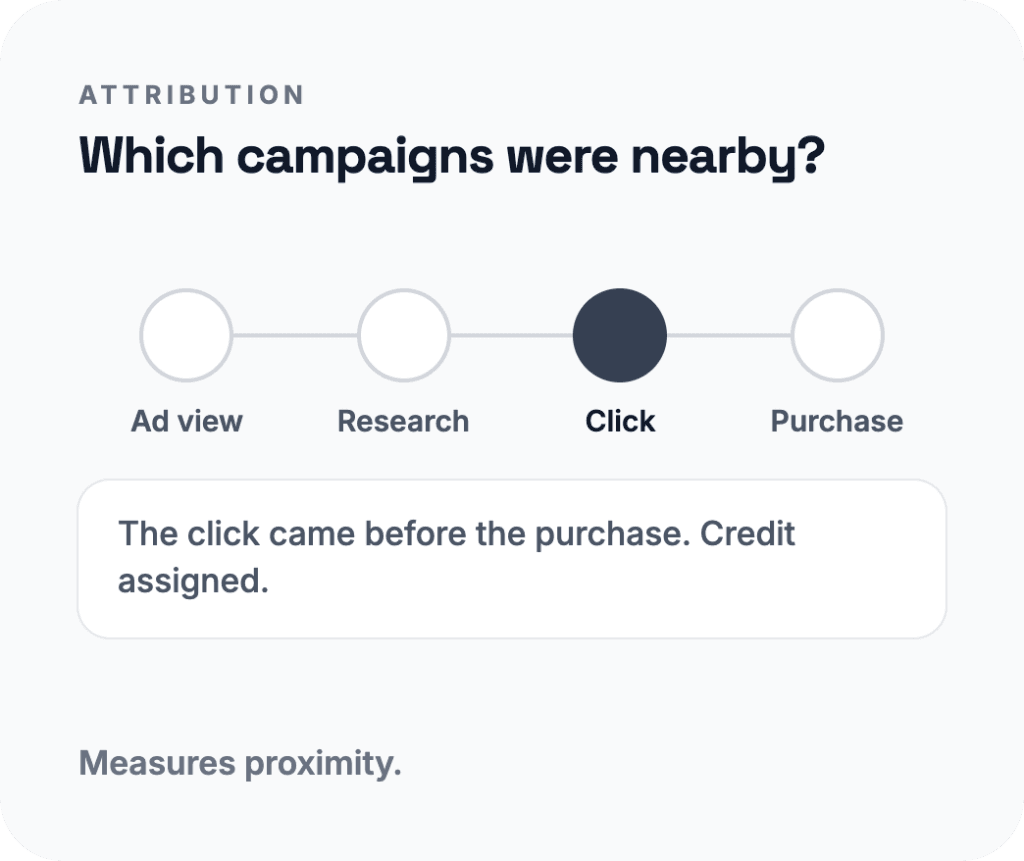
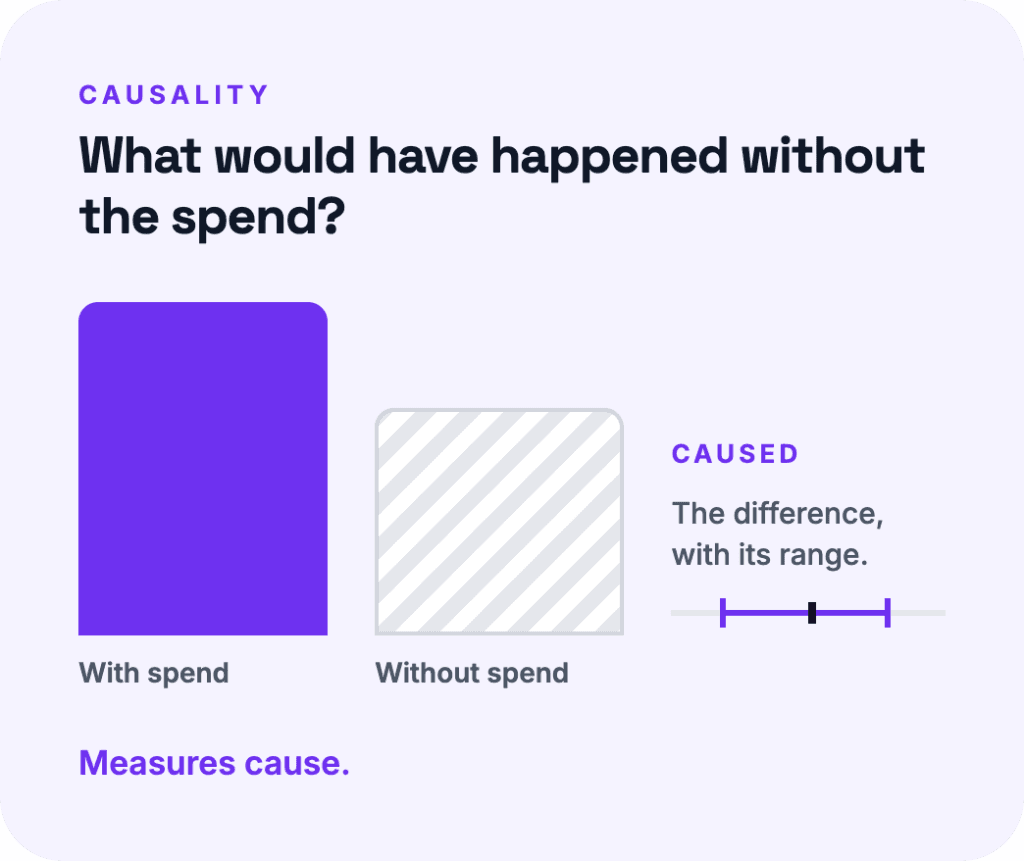
Ask a dashboard which campaigns drove last quarter’s revenue and it will tell you, with total confidence, which campaigns were nearby when the revenue happened. The ad got a click. The click came before the purchase. Credit assigned. That’s attribution, and it has its uses. But it isn’t the question a budget decision depends on. That question is simpler and much harder: what would have happened if we hadn’t spent the money?
If you’ve ever walked a CFO or a board through a marketing report, you know the private version of this problem. You’re standing behind numbers you don’t fully believe, hoping nobody asks the hard question. Mediaura Signal was built to answer it.
Why Attribution Breaks & What Incrementality Testing Measures Instead
Attribution has a logic problem and a data problem. The logic problem is that it measures proximity, not cause. The data problem is that even the proximity is usually measured badly, and it tends to fail in four places:
- Tracking decays quietly. Tags pile up, properties duplicate, a site release ships and a pixel stops firing. Nobody notices until a quarter of budget decisions have been made on corrupted data.
- Identity fractures across the journey. One customer sees an ad on their phone, researches on a laptop, calls the front desk, and walks in. Your analytics counts four strangers and credits none of them.
- Platforms grade their own homework. Google reports Google’s wins. Meta reports Meta’s. Add every platform’s claims together and the total can easily exceed the revenue you actually booked.
- Revenue lives where tracking doesn’t. Money changes hands at the POS, in the CRM, on a phone call, at intake. Measurement that can’t reach those systems optimizes toward form fills and hopes they correlate with dollars.
Put a better dashboard on top of that and you get a prettier wrong answer. There’s a name for the result: attribution theater. Confident numbers that win the meeting and lose the money.
What Signal Does
Signal is a causal measurement platform. It fixes the data first, then measures cause instead of proximity. It’s built as one connected system rather than a dashboard bolted onto whatever data you already have, because causal measurement is only as good as the data underneath it. Each layer exists to make the one above it trustworthy.
- Signal Tracker. First-party capture on your own domain. It records the events off-the-shelf pixels miss and connects systems that don’t talk to each other.
- Identity Resolution. Events are stitched to a single customer record across devices, sessions, and offline touchpoints, wherever the data supports the match. One customer, not four strangers.
- Revenue Mapping. Closed transactions are mapped back to the campaigns that earned them, whether the sale lands in a POS, a CRM, an EMR, or on a phone call. When sources disagree, Signal surfaces the conflict instead of quietly picking a winner.
- The Mediaura Causal Engine (M-CE). The layer that answers the question the rest of the stack sets up: what would have happened without the spend? It runs multiple independent models, validates them against geo-holdout experiments where you run them, and refuses to publish a number it can’t defend.
Aura, Signal’s AI analyst, works inside the platform to help you read the results. Aura doesn’t do the math. The models do.
Every reporting period, against your latest data, Signal produces three answers: what the spend caused, stated in dollars; how sure it is; and what a change would be worth, including the moves it evaluated and rejected so the reasoning stays auditable.
What Makes it Different
Plenty of tools promise better attribution. Signal isn’t trying to win that race. It’s asking a different question, and it’s built around a few commitments most measurement products avoid.
It measures cause, not credit. When Signal estimates that a channel caused a dollar figure, it means an estimated amount that would not exist without that spend. Not the revenue the channel happened to be standing near.
Every number carries its confidence. Signal publishes a range, not just a point. When a geo-holdout design is in place, results are causal estimates calibrated against it. Without one, they’re statistical associations, and Signal labels them that way. A number that admits uncertainty is a number you can actually use.
Disagreement is shown, not hidden. Multiple models score every channel independently, and you see where they agree and where they don’t. Forecasts are scored on data the models have never seen and have to beat a simple seasonal baseline to count. Channels where the models disagree become the recommendation for your next geo-holdout, which you approve and your team or agency runs. Disputes get settled by evidence, not by whichever model looks best.
It’s a referee, not a player. Signal measures. Whoever runs your marketing acts. That applies to every agency in your stack, including us.
It speaks in operator terms. The readout is in contribution margin, cost per admission, cost per cover: the numbers a CFO already uses. Not impressions and arrows pointing up.
Where it Fits
Signal is built for organizations where the sale happens somewhere tracking can’t easily follow.
Healthcare and behavioral health. Here even tracking is a problem: the major ad platforms won’t sign a Business Associate Agreement, which leaves most health systems choosing between risky pixels, no measurement, or compliant pixels that still don’t measure anything causal. Signal is built for HIPAA-regulated organizations, with a BAA included and executed before any data moves. The conversion it measures against is an admission, not a form fill.
Multi-location restaurant and retail. Revenue lands at the POS, location by location. Signal connects that revenue to spend and reports it in terms like cost per cover. A multi-location footprint also lends itself to geo-holdout testing, which is how causal estimates get calibrated.
B2B. Deals close in the CRM, often months after the first touch. Revenue Mapping ties closed revenue back to the campaigns that earned it, so pipeline decisions aren’t made on lead volume alone.
How to Start
You shouldn’t take any model’s word for it, including ours. So Signal starts by proving itself on your own history.
- The Fit Check. A free data-sufficiency assessment before you pay anything. If your volume can’t support causal confidence, we’ll tell you and part friends.
- The Backtest. We replay 12 to 36 months of your data through the causal engine and show you the specific decisions the evidence would have changed. Fixed fee, fixed timeline, and the analysis is yours to keep whatever you decide next.
- The Verdict. A readout in operator language: what was causal, what was coincidence, and what it means for next quarter’s budget.
If you’d like one number with incrementality results that you can defend to the board, start with the first step. Book your Fit Check at mediaura.io.
Bold patterns. Boring rigor.
FAQ
What is incrementality testing?
Incrementality testing estimates how much of your results would not have happened without the spend. It answers a different question than attribution, which assigns credit to campaigns that were present before a conversion.
How does holdout testing work?
In holdout testing, you withhold spend from some markets or audiences and compare their results with the markets where spend continued. The gap is the estimate of what the spend caused. A geo-holdout does this by region, which suits multi-location businesses.
What is the difference between attribution and causal measurement?
What is the difference between attribution and causal measurement?
Attribution measures proximity: which touchpoints came before a sale. Causal measurement estimates what the spend caused, meaning revenue that would not exist without it. Platform-reported conversions are attribution. Only holdout tests, geo experiments, and validated model output support a claim of incrementality.
Can you measure incrementality without a holdout test?
While there are systems that allow you to do this without a holdout, the reliability of those measurements will vary by industry. This becomes more challenging when dealing with offline conversions and regulated industries. Without a designed test, Signal doesn’t guess. Where the data can’t separate the effect of your ads from everything else, it says so and tells you what test would answer the question, and how big it needs to be. When a geo-holdout or switchback runs, Signal reads it directly, and that result then anchors future readings.
Will you sign a BAA?
Yes, every Mediaura Signal client that operates in healthcare requires a signed BAA as part of the sign-up process.
How secure is your system?
While we have operated under strict security protocols for many years, Mediaura is currently in the process of establishing our SOC2 Type 2 certification. We are working with Vanta and Workstreet and can provide an attestation letter upon request.