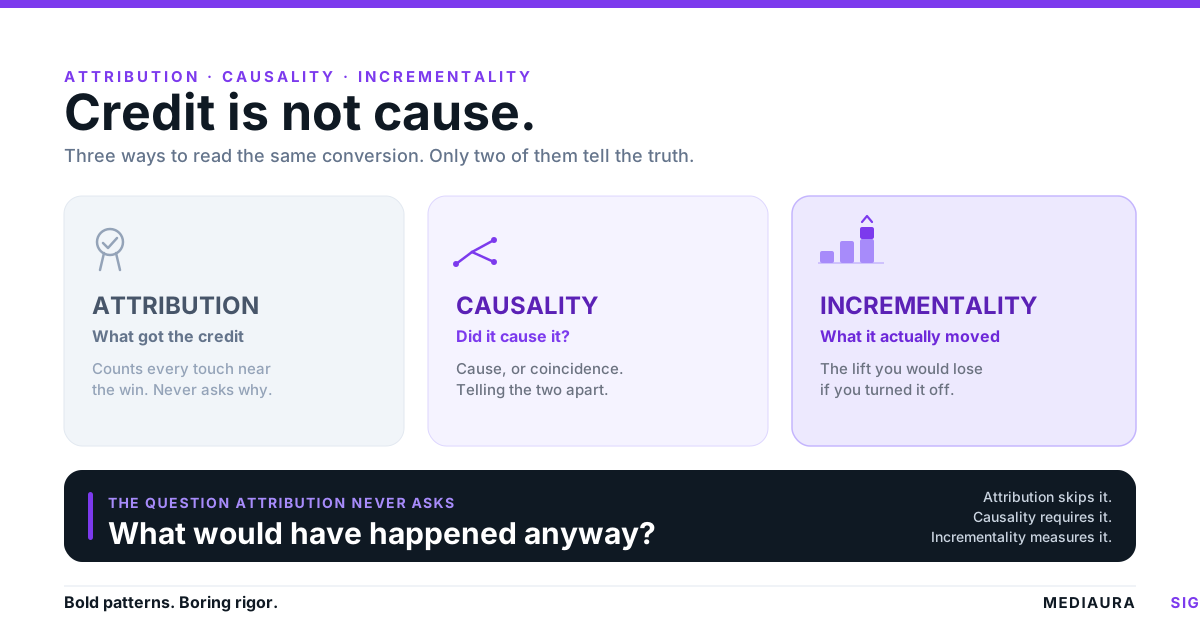
Two words get used interchangeably in every marketing meeting. They are not the same thing, and the gap between them is where most of your budget quietly disappears.
Here is the part nobody wants to say out loud. The report on your screen was built to flatter you. It tells you what worked. It rarely tells you the truth.
Let me fix that.
Causality is the question. Incrementality is the answer.
Start with the confusion, because these two words are not rivals. Incrementality is causality with a number on it.
Causality is the question: did your marketing actually cause the result, or did the result happen for other reasons and your marketing just happened to be standing nearby when it did? Cause, or coincidence.
Incrementality is the answer expressed as a quantity: how much of the outcome exists only because of the marketing. It is the lift. The part that would not have happened anyway.
Read that last phrase again, because it is the whole article. The part that would not have happened anyway.
Attribution is the impostor
Both causality and incrementality stand against the thing most marketers mistake for both: attribution.
Attribution records what was present when a conversion happened and hands out credit for it. Last click, first click, some data-driven model splitting the pie. It is bookkeeping. It tells you which touchpoints were in the room when the deal closed, and nothing more.
What it never asks is the one question that separates credit from cause. What would have happened anyway?
Picture someone who already decided to call you. They type your name into Google, click the paid ad sitting at the top, and convert. Attribution stands up and takes a bow: paid search drove that customer. Except they were always going to find you. They would have clicked the organic listing one line down, for free. The credit is real. The cause is close to zero. You just paid for a customer you already had.
What would have happened anyway
That question is the entire game, and here is how the three ideas line up against it.
Attribution never asks it. Causality requires it. Incrementality measures it.
The only honest way to answer it is to run the world both ways. Show the ad in one place, hold it back in a comparable place, and measure the difference between them. That is what a holdout test does, and it is why the word incremental only means anything next to a baseline. There is no incrementality in the abstract. There is only incremental versus something, and your number is exactly as trustworthy as the comparison you measured it against.
The rooster and the sunrise
If you want to feel the difference in about five seconds, think about the rooster.
The rooster crows every morning. The sun comes up every morning. Perfectly correlated, every single day. Attribution credits the rooster for the sunrise.
Causality asks whether the rooster actually makes the sun rise.
Incrementality asks how many fewer sunrises you would get if you silenced the rooster. The answer is zero. That zero is the rooster’s real value, and the only way to find it is to turn it off.
Most marketing budgets are full of roosters. Channels crowing next to a sunrise that was going to happen with or without them.
What it looks like when real money is on the line
Here is how this plays out with actual stakes, in behavioral health, where we do a lot of our work.
The attribution report gives the Google brand click the credit and declares Google the driver. Leadership looks at it and starts asking why they are paying for Meta at all, since Meta shows almost nothing. So they cut it.
Someone in crisis sees an awareness ad on Meta. They are not ready. They sit with it for weeks. Eventually they search for your treatment center by name, click the paid brand ad, call, and admit.
The causal questions are completely different. Did the Meta awareness cause that journey to begin in the first place? And would that admission have found you anyway through the organic listing, even without the paid brand click?
Incrementality answers both with numbers. It surfaces the admissions that exist only because Meta created the awareness that started everything. And it exposes the channel quietly doing the real work while a different channel collects all the credit. Cut the wrong line and your admissions fall. That is the costly mistake, and attribution walks you straight into it.
Credit is not cause
So the next time someone asks you the difference, here is the whole thing in one breath.
Attribution tells you what got the credit. Incrementality tells you what made the difference. Causality is the discipline that lets you tell those two apart.
Everything else is decoration.
This is the standard we hold at Mediaura, and it is what we built Mediaura Signal to do. Not a prettier dashboard. A neutral measurement layer that sits above your channels, has no incentive to inflate any of them, and stays anchored to the outcome that actually pays your bills. Bold patterns. Boring rigor.
If your reporting has never once told you something you did not want to hear, it is not measuring. It is flattering you. We think you deserve to know the difference.