
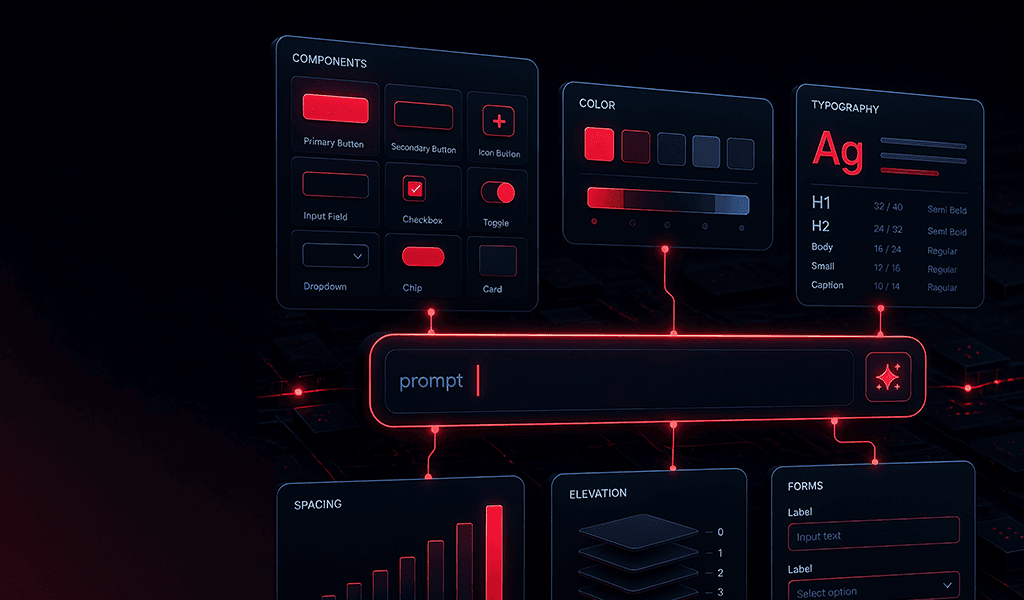
AI has changed the pace of creative work in a huge way. It is now possible to spin up hero sections, landing pages, ad creatives, and social posts in the time it once took to set up a project file. So why should you need design system development services at all?
What has not changed is the need for a brand to stay consistent, recognizable, and distinct. Speed is helpful, but branding still depends on repetition and clarity. If AI is allowed to generate things without any real guardrails, it fills in the blanks with whatever style seems right in the moment — and that style is rarely the same every time.
A brand still needs:
- Consistency
- Recognizability
- A clear personality
In this blog, we’ll explain what a design system is, how it’s different than simple brand guidelines, and why design system development services really are the best way for businesses to create consistent branding that supports their business goals.
How AI Can Quietly Erode Your Brand
The tricky part is that AI is very good at following vague instructions. That sounds helpful until vague prompts start producing vague, inconsistent results.
A prompt like, “Give me a modern landing page with a bold headline and a CTA,” sounds clear enough on the surface. But AI will still make its own choices about font, spacing, color palette, and button style. Run that same prompt a few times and the results may all look polished, but they will not necessarily look like they came from the same brand.
Then it spreads. Marketing uses AI for social posts. Sales uses it for decks. Someone else uses it for email graphics. Before long, the brand starts to feel like a mix of slightly different blues, slightly different fonts, and slightly different tones of voice. That kind of drift chips away at trust because people stop recognizing the brand instantly, even if they cannot explain exactly why.
Why Your Brand Needs A Design System, Not Just Guidelines
The Shift Toward Design System Development Services
In the AI era, design systems are no longer optional. They’re essential. In 2026, the complexity of managing AI outputs across multiple departments means that investing in professional design system development services is a foundational step for long-term brand equity. The easiest way to think about a design system is as the operating system for the brand.
A design system includes:
- Design tokens, which are named values for colors, typography, and spacing
- Components, such as buttons, cards, forms, and navigation
- Patterns, like hero layouts, pricing sections, and feature grids
- Rules for how and when each piece should be used
Traditional brand guidelines are usually more general. They might include a logo sheet, a color palette, and a few examples of what to do and what not to do. That is useful for humans, but it is often too fuzzy for AI.
A design system gives more specific direction. It defines which color is used for main calls to action, how heading sizes should be applied, what a primary button should look like, and how common sections should be structured. Once those things are defined clearly, your AI-ready design system can work within the brand instead of improvising a new version of it every time.
How Design Systems Improve Your AI Prompts and Output
The design system difference shows up immediately in your AI prompt.
Without a system, the prompt sounds something like: “Design a landing page for my SaaS product that feels modern and clean.”
With a system, the prompt becomes much more specific: use the primary brand color for calls to action, use the approved heading and body fonts, use the primary button style for key actions, and build the page using a hero, features, testimonials, and pricing layout.
That second version gives AI something solid to work from. It knows the colors, the typography hierarchy, the button style, and the layout logic. Instead of inventing the brand from scratch, it is assembling something new from parts that already belong to the same system.
That is what makes AI actually useful in a long-term way. It still saves time and gives fast options, but the output feels like one brand instead of several competing ones.
Building an AI-Ready Design System: The Mediaura Approach
The truth is, it’s easier to make an AI-ready design system when you have an actual design background.
I am Mediaura’s creative director and have 11 years of experience at my job, creating brand guides, social designs, websites, and complete design systems.
At Mediaura, we have been shaping brands for 22 years, creating visual identities that align with business goals.
We also know how to strategically apply those brand guidelines to make creative that converts — on your website, digital ad platforms, and social profiles.
Partner with Mediaura for Your Brand’s Operating System
Don’t let AI tools accidentally dilute the brand equity you’ve spent years building. If you are ready to secure your brand’s future consistency with an AI-ready design system, we can help.
For help with comprehensive design system development services, and using your system the right way, reach out to us.
FAQ
1. Isn’t a brand guideline PDF enough for AI?
Not really. A PDF is helpful for humans, but it usually does not include the level of detail and structure AI needs. It may show colors and fonts, but it often does not define exact components, patterns, and rules. A design system fills in that gap and makes the brand much easier to apply consistently.
2. Do small businesses really need a design system if they are only using AI here and there?
Yes, especially if AI is being used even a little. A simple design system helps make sure the things AI creates—like social graphics, ads, landing pages, or email visuals—still look intentional and on-brand. It saves time, reduces unnecessary revisions, and helps the business look more polished everywhere customers see it.
3. Why should a business care about a design system if AI already makes things faster?
Because speed without consistency usually creates more cleanup later. A design system helps every AI-generated asset still feel like part of the same brand. That means less back-and-forth, fewer redesigns, and a more trustworthy and professional presence across every platform.
4. How does AI design improve website conversion & user experience in web design?
AI enhances website conversion and user experience by adapting design layouts to better match user intent and behavior. Instead of relying on static page structures, AI can prioritize the most relevant content, calls-to-action, and visual hierarchy — guiding users more intuitively through the experience.
This only works effectively when supported by an AI-ready design system, best created via professional design development services. With consistent components, spacing, typography, and visual rules in place, AI can rearrange layouts without breaking the brand or user experience. Rather than guessing how elements should look, it uses pre-designed building blocks to create cohesive, high-performing pages that feel intentional and user-focused.


